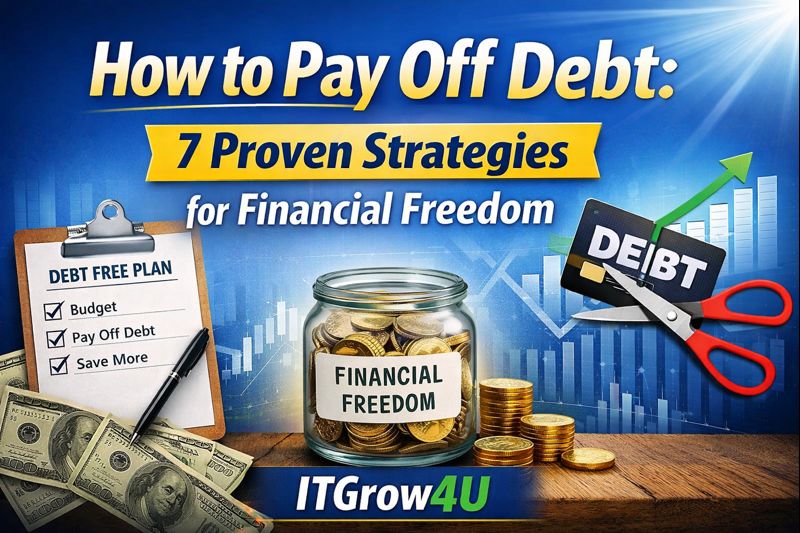
Introduction: Learn How to Pay Off Debt and Improve Your Finances
Learn how to pay off debt with simple, practical strategies to regain financial control and improve your money management with ITGrow4U.
Debt can sometimes feel like this never-ending cycle where you make a payment but it barely puts a dent in the balance and somehow those interest charges just keep piling on.
However, there are practical strategies that can help you learn how to pay off debt in a more manageable and structured way.
Frugal creative living and in this post I’m going to share some practical and effective tips for paying off debt faster, some that maybe you hadn’t really considered before.
So if you want to learn how to pay off debt and improve your financial situation, keep reading.
Call Your Debtors: A Key Step in How to Pay Off Debt
Tip number one is to call your debtors. It may feel uncomfortable, but reaching out to your creditors is an important step.
When I had debt and I hadn’t yet made a plan to pay it off.
I used to run from debt collectors. I used to hate to see their numbers pop up on my phone.
How to Pay Off Debt by Contacting Your Creditors
When I finally decided to stop running from my debtors, I sat down.
And I made a list of every debt that I owed and started calling every single one of them.
How to Pay Off Debt by Understanding Your Balances and Interest
First of all, I was able to get clear on exactly what I owed.
What the interest rates were for each debt, and what the minimum payments were.
How to Pay Off Debt Through Negotiating Payment Options
When I told them that I was having difficulty paying and asked them.
If we could work something out, they started telling me about special programs.
I could get into and agreements that they could make.
Options Like Reduced Interest and Structured Payment Plans
Some creditors may offer options such as reduced interest rates, interest-free periods, or structured payment plans depending on your situation.
Benefits of On-Time Payments and Payment Programs
I was on a program where for every on-time monthly payment that I made.
They agreed to take 12% off of the amount that I owed.
The Role of Consistency in Negotiating with Creditors
In some cases, consistent payments may lead to negotiations with creditors, though results can vary.
Don’t Hesitate to Ask About Available Options
Sometimes you just don’t know what’s available to you simply because you don’t ask.
How to Pay Off Debt Faster by Making Timely Payments
Tip number two is to create a budget. Now anytime you’re trying to accomplish.
Something new as it relates to your money, you should start by creating a budget.
It’s just going to give you a clear picture of your current income.
How much you have available to apply to your debt, and any unnecessary spending.
That you need to cut out so that you can get your debt paid faster.
How to Pay Off Debt Faster by Identifying Which Debts to Prioritize
So you’ll be able to see which debt you want to get aggressive with and pay off first.
How to Pay Off Debt Faster by Targeting High-Interest or Small Debts
It might be the debt with the highest interest rate.
That you want to pay off first in order to reduce the amount of interest.
That you’ll be paying over time, or you could start by paying off the smallest debt.
First just to get you some of those quick wins.
Prioritizing Debt Repayment Above Discretionary Spending
And when you’re creating your budget, you want to treat your debt repayment like.
It’s a mandatory bill and prioritize it above your discretionary spending.
How to Adjusting Your Budget to Prioritize Financial Goals
If it helps, you can use the 50/30/20 rule as a guide which typically.
Just means that you allocate 50% of your income to your needs like rent and utilities.
30% to your wants or discretionary spending, and 20% to financial goals like debt repayment and savings.
Modifying Budget Percentages to Prioritize Paying Down Debt
But in this case, you can adjust the percentages as needed in order to prioritize.
The debt repayment above the discretionary spending.
How to Pay Off Debt Efficiently with Consistent Payments
Tip number three, if you didn’t catch my drift in tip number one, make your payments on time.
First of all, it’s going to help you avoid those late fees.
Which are going to increase your balance and make it take longer to pay off what you owe.
Avoiding Late Fees Through Regular Payments
Secondly, if you’ve already been making payments.
When you reach out to those creditors looking for special programs and waivers.
Sometimes they’re going to go and look back at your payment history in order to determine whether you qualify for what they have available.
How to Pay Off Debt Smoothly by Automating Your Payments
Tip number four is to automate your payments if you can.
Forgetting to make a credit card payment can result in additional fees and increased balances.
How to Pay Off Debt Smoothly with Automated Payment Strategies
I have a credit card with a $200 credit limit that I use every once in a while, especially because of the cashback deals that are available on it.
Using Autopay to Maintain a Safe Payment Cushion
Balance is small enough that I can just pay it off within the month, I do that.
Also have the account on autopay and I have the date set to make the payment about 2 days before it’s due, just in case something comes up.
I don’t know what can come up, but I just like to have a cushion just in case.
How to Pay Off Debt Using Cash and Debit-Only Strategies
Tip number five is to use cash or your debit card only. When you’re trying to pay off debt, you want to make sure that you’re not introducing new debt into the pot.
If you’re only using cash or a debit card while you’re paying down your debt, it’s going to cut off new debt entirely.
Encourage Disciplined Spending with Cash-Only Practices
This approach limits the use of credit cards and small loan programs, encouraging disciplined cash-based spending.
How to Pay Off Debt Effectively with Cash and Debit Management
I mean you don’t want to keep adding debt on while you’re trying to pay your debt off, you’ll just have yourself in a debt loop forever.
It’s just going to help you to prioritize paying off what you owe.
Manage Your Expenses by Following a Strict Cash Budget
So for instance, if you set your grocery budget at $100 per week, you can only use cash or what’s in the bank for your purchases.
The cash runs out, you have to wait until your next budget period to pick up any additional items you might need, or you make adjustments to your budget to cover the extra expenses. Just don’t use credit of any kind.
How to Reduce Your Debt Quicker with Extra and Partial Payments
Tip number six is to make more frequent payments if you can swing it and if your particular debtors allow you to make partial payments.
My suggestion is that you take your monthly payment and split it into two payments, and then making that half payment every two weeks instead of making one whole payment once a month.
How to Pay Off Debt Faster by Splitting Payments
This method results in an extra payment over the course of a year, which can help reduce your principal balance more quickly.
Lower Interest Costs by Paying More Frequently
But even if you don’t make a payment every 2 weeks, just making a half payment in the middle of the billing cycle and then another half payment by the due date.
You’re lowering your principal balance more frequently which means that there’s less interest accruing on the remaining balance throughout the life of the debt.
How to Pay Off Debt Safely by Checking Payment Platform Rules
And like I said, some online payment platforms may not allow you to make partial payments, but you won’t know unless you try.
How to Make Consistent Progress with Small, Extra Payments
Now if you’re on a really tight budget or maybe you don’t have a steady and consistent income, this next one might be all that you can do, and that is to make snowflake payments.
And what that means is that you’re making small frequent payments towards your debt whenever your money comes in.
How to Pay Off Debt Consistently with Snowflake Payments
It could be from side gigs, selling used or unused items, some savings on a bill.
How to Pay Off Debt Faster by Using Savings for Snowflake Payments
So let’s say you budget $100 for groceries for the week, but because you used your grocery store app and applied those digital coupons, you saved $20.
How to Pay Off Debt More Quickly with Side Income Payments
Or maybe you earned $15 from selling old clothes on Poshmark. Instead of keeping that money or spending it, you make a snowflake payment towards your debt.
Consistently Paying Small Amounts Helps Reduce Debt
Making small, frequent payments can help you make consistent progress when learning how to pay off debt over time.
Gain Control Over Your Debt with Regular Small Payments
And those snowflake payments can also help provide a sense of control and consistent progress towards your goal.
Generate Extra Income to Support Debt Repayment
So in a situation like this where your income is inconsistent or really low.
I would suggest that you list out about 10 ways.
That you can generate a little extra income and then choose a few of them to focus on each month to help.
Make sure that you have enough to pay your minimum payment amounts due.
How to Pay Off Debt Quickly by Allocating All Extra Income
And really, increasing your income, even if you already have consistent income, can be a great way to speed up your debt payoff process.
How to Pay Off Debt Faster by Committing Extra Earnings
If you commit to putting all of the additional income directly towards debt repayment, it’s going to speed up your payoff timeline and reduce the interest cost.
Focus on Temporary Side Jobs Until Debt Is Reduced
And you don’t have to have that side job forever, you can just commit to having it until your debt is paid off or paid down or wherever you want it to be.
Tips to Stay Motivated While Reducing Your Debt
Tip number nine is to find ways to stay motivated.
Paying off debt requires consistent effort over time.
So finding ways to stay engaged in the process and motivated throughout the process can make all the difference in you completing the process.
How to Pay Off Debt Successfully by Setting Clear Goals
When you start, decide how much you want to pay off and then set a date for when you want to have it paid off.
How to Pay Off Debt Faster by Breaking It into Smaller Milestones
Then break down those big goals into smaller milestones, and you can take the full sum of all you owe and divide it into manageable chunks like a $500 or $1,000 milestone, or you can set smaller goals for each month.
Keep Motivated by Writing Down Your Reasons
Just write down why you want to be debt-free and keep reminding yourself of the reason.
Monitor Your Debt Payoff with Charts and Progress Tracking
Helps when you can visualize your own progress.
Whether it’s making a payoff chart or using an app or just crossing debts off on a paper or using a debt thermometer, seeing how far you’ve come can be such a motivator to help you keep running to the finish line.
How to Pay Off Debt Faster by Tracking Your Progress
Remember, the journey to being debt free is different for everybody, so you have to find the things that motivate you the most.
How to Pay Off Debt Effectively by Sharing Your Progress
Let me know in the comments which of these tips you found most helpful or which tips you’d like to hear more about, or even if you have some other debt payoff tips.
Conclusion: Key Steps to Regain Financial Control and Stability
Managing and paying off debt is a journey that requires patience, consistency, and a strategic approach.
By understanding your financial situation, prioritizing your payments, and using practical method.
Such as budgeting, automated payments, snowflake payments, and disciplined spending, you can steadily regain control over your finances.
Each small step, whether it’s making on-time payments, reaching out to creditors, or finding ways to increase income, adds up over time, helping you reduce interest costs and move closer to financial freedom.
Staying motivated, tracking progress, and celebrating small milestones ensures that the process remains manageable and empowering rather than overwhelming.
Ultimately, the key to successfully paying off debt lies in taking deliberate, informed actions while maintaining a positive and proactive mindset.
With commitment and consistency, you can transform your financial habits, eliminate debt, and build a foundation for long-term financial stability.
Start today by implementing one practical strategy and gradually incorporate the others, your journey to financial freedom begins with the first step.
Share your progress or tips in the comments below, your experience could inspire others to take control of their finances too.