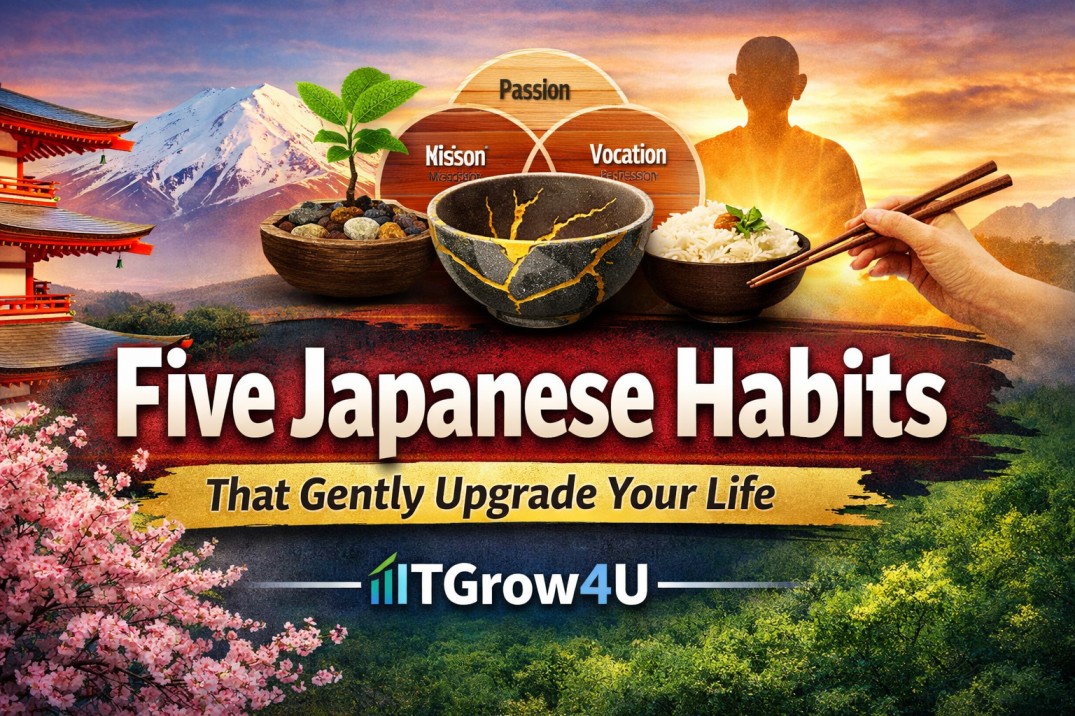
Introduction: Five Japanese Habits That Gently Improve Your Life
Discover Five Japanese Habits that gently improve your life. Learn practical, mindful routines to boost calm, focus, and lasting well-being — by ITGrow4U.
Let me ask you something. Why do some people move through life with a calm and energy, but you can’t? And why do certain people seem grounded, disciplined, and focused without forcing anything? Maybe you’ve even met someone like this.
They have no wealth or lucky breaks, nor do they have any inherent talent, yet they’ve all created lives that work; they appear calm and in control at all times, and their life appears calm, balanced, and peaceful.
Most people do not know or see the reality of what is actually happening, to live life to its fullest.
How Five Japanese Habits Transform Your Mind, Character, and Life
Great lives are not built by big or dramatic decisions. They’re built by tiny habits. Small actions so simple, but they shape your mind, your character, and your future.
Initially, these habits may seem inconsequential; however, over time they subtly transform you from who you are today into an entirely new person. The Japanese have been doing these simple habits for centuries.
Not as trends, not as aesthetic routines, not as life hacks, but as a way of living, a way of becoming calm, disciplined, and deeply intentional.
Today, I will share with you five simple habits to help you gently and permanently elevate your quality of life. Some of these take only five seconds to complete, and others can be life-changing in terms of how you treat yourself.
Practicing a single habit throughout generations has allowed complete towns in Japan to achieve longevity beyond 100 years old! Deep breath… Breathe out. By the end of this article, you will have actionable steps in front of you that will lead you toward living an extremely calm, strong, and fulfilling life.
So without any further delay, let’s begin.
Five Japanese Habits: Kaizen for Daily Life Improvement
You know that feeling when you want to change your life, but it feels like you’re standing at the bottom of a giant mountain.
You want to get healthier, but the gym feels overwhelming. Or You want to be more productive, but your to-do list looks impossible. You want to improve your life, but you don’t even know where to start.
But Japan has a solution so simple that most people ignore it. It’s called Kaizen. The habit of improving just one tiny thing every single day.
Kaizen not changing your whole life in just one week. And not forcing yourself to work like a machine, but just one small improvement. But here’s the real magic happen.
Kaizen: One of the Five Japanese Habits That Gently Upgrade Your Li
Kaizen is not focused on the improvements made through the process of continuous improvement, but rather on generating a positive identity momentum for an individual to have the confidence to continue moving forward even with a very small, incremental movement.
Let me show you how powerful that is. Imagine you do one push-up today. Just one. People might laugh at that, but tomorrow you do one more.
You could start with 1 (an improvement) and then have so many increments of renewed quantity of items that you would soon be able to do 10 (an improvement) daily without even noticing it. This is the reason Kaizen works. Your brain loves small successes as you improve.
When something feels small and simple, your mind doesn’t fight it and it doesn’t resist. And tiny habits slip past the mental friction that usually kills big goals.
So instead of asking, “How do I change my whole life?” Start ask what is the smallest action I can take today? Because kaizen is not about intensity, it’s about consistency.
So when you improve a little every day and you eventually become the type of person who grows without forcing it, then your life upgrades slowly, quietly, and naturally.
Five Japanese Habits: Ikigai to Discover Your Life Purpose
Let me tell you something that most adults never say out loud. A lot of people wake up every morning with a quiet emptiness inside them. It’s not depression and it’s not sadness.
It’s just a missing direction. You’re working and you’re doing what you should. But somewhere inside something feels unfinished. Like you’re alive but not fully living.
Finding Meaning and Purpose Through Daily Practices
But Japan has a word for that missing piece. It’s ikiguai. Your reason for being. See your eeky guy is not your job and it’s not your duties and it’s not what society expects from you.
Eeky is like your reason – the reason (the why) you are alive, eeky is an ideology rather than a credential or degree and used every day. Eeky believes that you will extend your life and increase your happiness through consistent use of Eeky.
So when you have something meaningful to wake up for. But here’s what many people get wrong. Your eeky guy doesn’t have to be a big mission.
And it doesn’t have to change the world. It just needs to light up your heart even a little. And your eeky guy usually sits at the crossroads of four simple questions.
What do you enjoy doing? Or What are you good at doing? What does the world require? How could you turn that into a source of income? You may have grown up with those questions, but there are many people who do not even have the answers to those simple questions.
You don’t need to answer all the four today because ikiguai is not discovered in one perfect moment. It slowly grows with you. It changes as you change.
How to Practice Ikigai: A Japanese Habit for Daily Fulfillment
So you can start with just one spark. Maybe you love cooking or maybe you love helping others or maybe you love building things or maybe you love learning new skills.
Whatever it is, follow the spark, not the pressure. Because eeky is something you cultivate, not something you magically find. So you discover it through curiosity, trying new things, making mistakes, and paying attention to what makes you feel alive.
And once you catch even a small glimpse of it, then life starts to feel different and more meaningful. Then your days stop feeling like a list of tasks.
They start feeling like steps on a path, a path that is uniquely yours.
Five Japanese Habits: Hara Hachi Bu for Mindful Eating
Imagine this for a moment. In Okinawa, before every meal, people pause, then take a breath and say a simple phrase, Hara Hachi Bu.
Another phrase for ‘What makes me full within my stomach, as opposed to eating to feel satisfied’ is to eat until you feel full but not feel heavy. Just because you like the taste of something does not mean you should eat it. Just because you feel satisfied from eating something does not mean that you will continue to eat it.
This represents only one habit that research has demonstrated to assist an individual with eating less; reducing the rate of aging, increasing the rate of older individuals developing inflammation, increasing their overall energy level, and ultimately, increasing overall longevity.
But the real beauty of Hara Hachi Bu isn’t just about food. It’s about reconnecting with your body. Because most of us eat on autopilot. We finish the plate because it’s full.
And we eat to avoid stress. And we eat to feel better emotionally, not physically. So, we stopped listening to the one thing that actually knows the truth, our own body.
And here’s the thing, your body is incredibly wise. It sends signals and it whispers when it’s full. And it knows what it needs. So, we just don’t slow down long enough to hear it because Hara Hachi Bu is not a diet and it’s not about restriction and it’s not about counting calories.
Hara Hachi Bu: Mindful Japanese Habit for Balanced Eating
It’s a mindfulness disguised as eating. So, here’s how you can try it in your next meal. Eat a little slower, then put your spoon or fork down between bites and pay attention to the moment your body feels comfortable.
Not hungry, not full, just balanced. And when you reach that quiet moment where your mind says, “Yeah, I think I can stop now.” It doesn’t feel dramatic and it doesn’t feel like sacrifice.
It feels like a respect. Over the time, your body begins to thank you. Your digestion improves and your energy rises. Then your mood becomes lighter.
Habits: Gaman to Build Patience and Resilience
See, life is tough sometimes. You already know that because everyone goes through moments that feel heavy, unfair, and painful. But the Japanese have a quiet, powerful way of dealing with these difficult moments.
A way that builds strength without bitterness. It’s called gam. To display patience, calmness, and self-control through the act of patiently enduring hardship. It doesn’t mean ignoring your emotions.
And that’s not the same as faking it and hoping everything will turn out okay, or pretending you’re not hurting when you are. What it means is that you understand that life is hard right now; therefore, while you will experience hardship, you will not allow this hardship to define you.
That is where GAM comes into play. GAM teaches you resilience and the ability to remain steady amid chaos and gives you the patience to face pain rather than running away from it, the discipline to keep it together no matter how messy life becomes, and the wisdom to not waste your time, energy and attention on things over which you have no control.
Gaman: Japanese Habit for Patience, Strength, and Resilience
By practicing GAM, something very powerful occurs. You stop responding catastrophically to every little challenge that comes along, you stop feeling panicked when something unexpected occurs, and you stop complaining about things you can’t change or wish you could change.
Then you become grounded, stable, centered, and unshakable because gam turns pain into resilience. Then it transforms quiet suffering into quiet strength. And even though no one may notice the work you’re doing inside, one day the world will see the difference.
Because the strongest people aren’t loud, they are the ones who learn to endure and rise.
Habits: Kintsugi for Healing and Growth
Out of all the Japanese habits, this one might be the most beautiful. In Japan, when a bowl breaks, they don’t throw it away, and they don’t hide the cracks, and they don’t pretend nothing happened.
To restore the cracks through using gold to fill the cracks. This art is called Kintsugi. And the broken bowl becomes even more valuable than it was before it shattered.
But Kintsugi is not really about pottery. It’s about your life because you have cracks, too. The moments that broke your heart and the situations that crushed your confidence and the experiences that made you feel unsafe and the times where you felt lost, fragile or completely shattered.
The Japanese wisdom says this, your cracks are not your weaknesses. They are the places where your strength grows and they are the places where the light enters.
Kintsugi: Japanese Habit for Healing, Resilience, and Growth
Kintsugi teaches something powerful. Healing doesn’t erase your past. It respects it and slowly it turns your pain into wisdom. So instead of covering your wounds, fill them with gold.
Acknowledge them and respect them and let them shine. Because the most inspiring people in this world are not the ones who never fell apart.
You are someone who has created themselves again after having previously failed, and you have the ability to recreate yourself for good using love, courage, patience and grace. You aren’t broken; you are becoming something more resilient and beautiful than you were in your previous existence.
Conclusion: Five Japanese Habits to Transform Your Life Consistently
These five Japanese habits aren’t loud or dramatic. They don’t demand perfect discipline, high motivation, or a complete life overhaul. They only require one thing from you.
One tiny step at a time; one moment at a time; one decision at a time; one experience at a time. Over time, your repeated habitual choices begin to rewire your mind, body, spirit, emotions, relationships, purpose, confidence and ultimately your entire life!
You don’t need to follow all habits right now. Or you don’t need to fix everything this week. Just pick one habit, one simple Japanese philosophy that you can stick with.
Because your life doesn’t transform when you do everything at once. It transforms the moment you decide to begin.